Tired of tips?

You ask ChatGPT about your idea and get tips. These fifty prompts make it do the work instead: check the demand, do the math, write to suppliers, plan the launch. Your numbers, the free plan, $9 once.

Buy the pack, $9 Launch price, regular $17. One payment, two files by email.

See three of them run on the idea from this video ↓

The video you probably came from, and the idea the three runs below use. The face is my AI twin; the ideas, the scripts and the launch plans behind the channel are run with prompts from this pack.

The channel these prompts run.

From the dashboard my team uses. Screenshots taken on 28 October 2026, cropped to views, likes and comments.

Instagram, TikTok and YouTube together, 28 September to 28 October:

Views, all-time: 13.13M Views, Sep 28 to Oct 29, 2026: 2.35M Likes: 43.7K Comments: 3.8K

Instagram alone, @vitaly.ideas, the same 30 days:

Instagram, last 30 days: 931.7K views, 15.8K likes, 3K comments

172 videos in those 30 days, 13 million views all-time. My day job is co-founder of 24.online, an AI content platform; the channel is where I test ideas in public.

Vitaly Tsoy at his desk
Me, not the AI twin.

Why listen to me.

My day job is running an AI platform that writes and manages product content for online sellers, a lot of them. These 50 prompts are not “content” I wrote to sell. They are the working patterns my team runs every day, trimmed down so that your first launch does not take 50 hours of guesswork.

Everything that is inside is on this page: the four stages, what each one covers, three real runs, two prompts in full. You know exactly what the $9 buys before you pay it. The face in the videos is my AI twin, scripted and run with prompts like these; the pack is what is behind it.

Vitaly Tsoyco-founder, 24.online
@vitaly.ideas, 56.7K followers

What people write under the videos.

Copied as written, from the comments under two of last week's videos. Every video gets the same three questions: where do I buy it, what does it cost, how do I actually do it. The pack is my answer to the third one, and it usually answers the first two along the way.

Handles shortened on purpose; the comments are public under the videos.

What you get back.

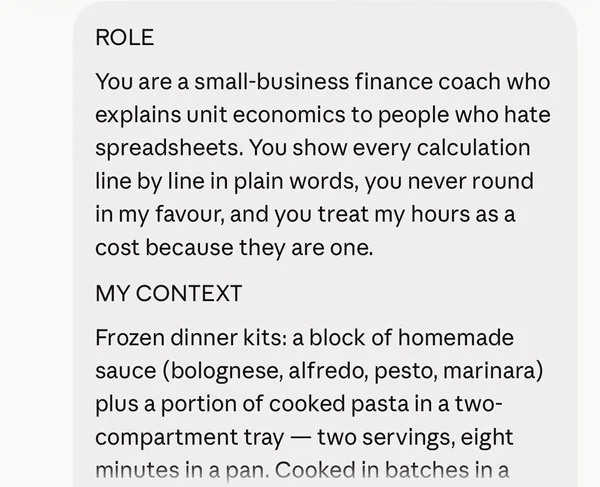
Two of the fifty, run on the idea from the video. I filled in the context the way a first-time founder in Austin would and pasted them into the free Claude app on a phone. Screenshots untouched apart from cropping.

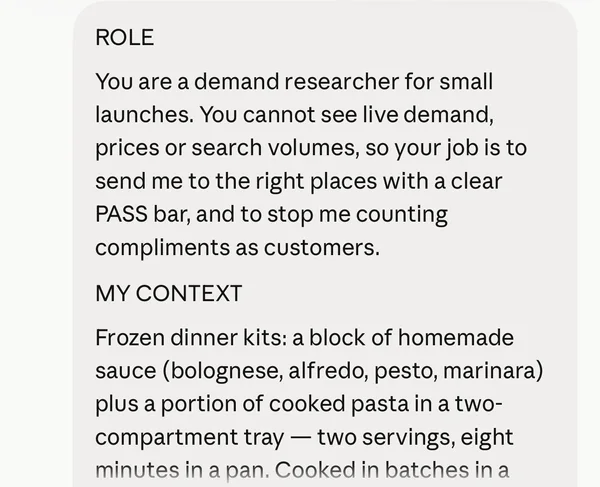
P04 · Demand Reality Check · run in the free Claude app on a phone, 28 October 2026

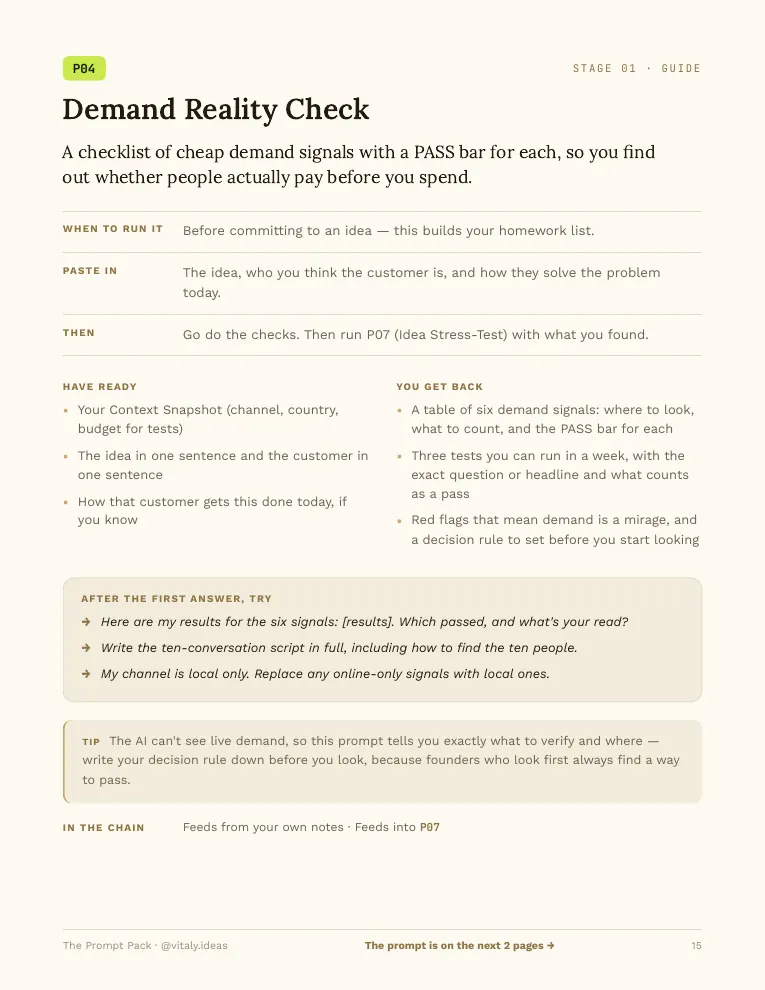
It sends you to six places to look, gives you a $5-deposit test, and a rule: stop if 15 paid orders don't come.

  • Six signals of real demand, where exactly to look for each, and what counts as a pass
  • Three tests for under $200: a deposit page, ten conversations, a poll
  • Red flags, and a decision rule you set before you look
  • “Check first”: ten minutes on three menus could end the idea today
Read the full answer, and all 5 screens
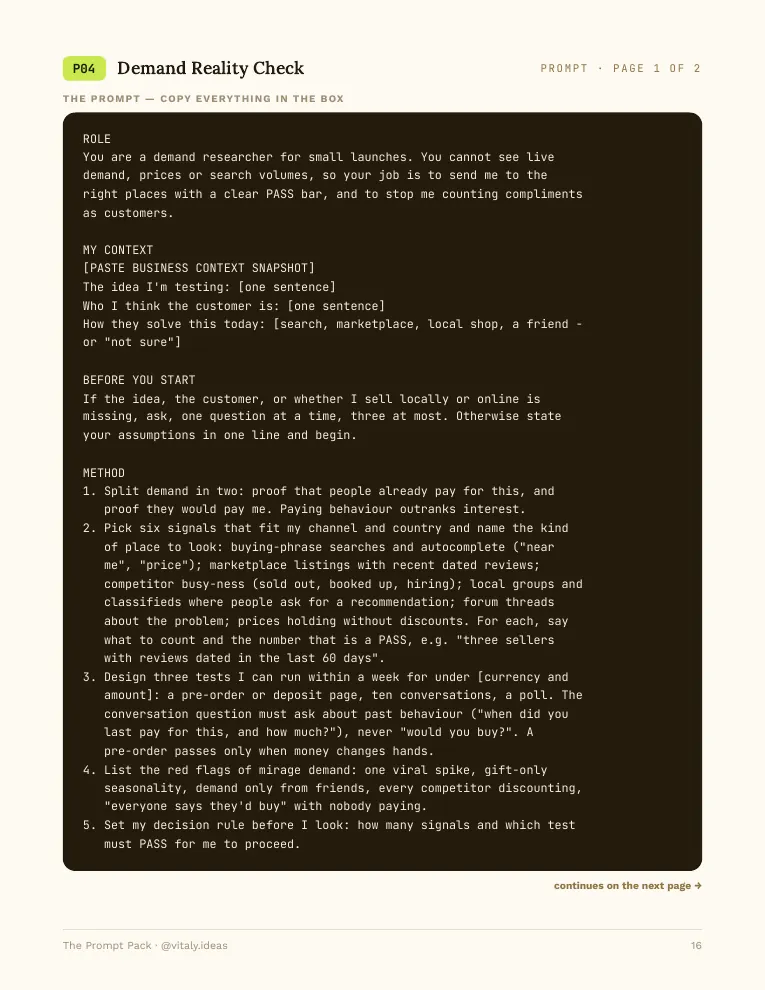
The prompt pasted into the Claude app
The prompt, pasted as is
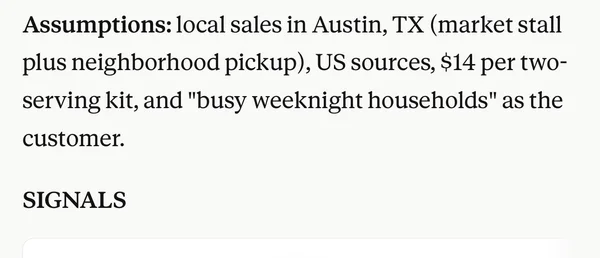
Assumptions stated first
It states its assumptions first
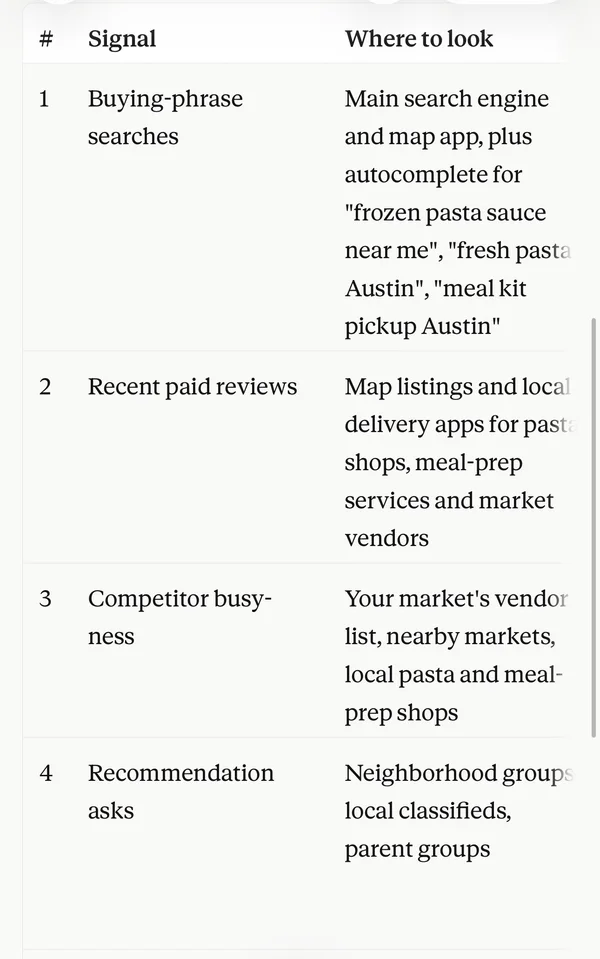
Signals table: where to look for each
Six signals and where to look
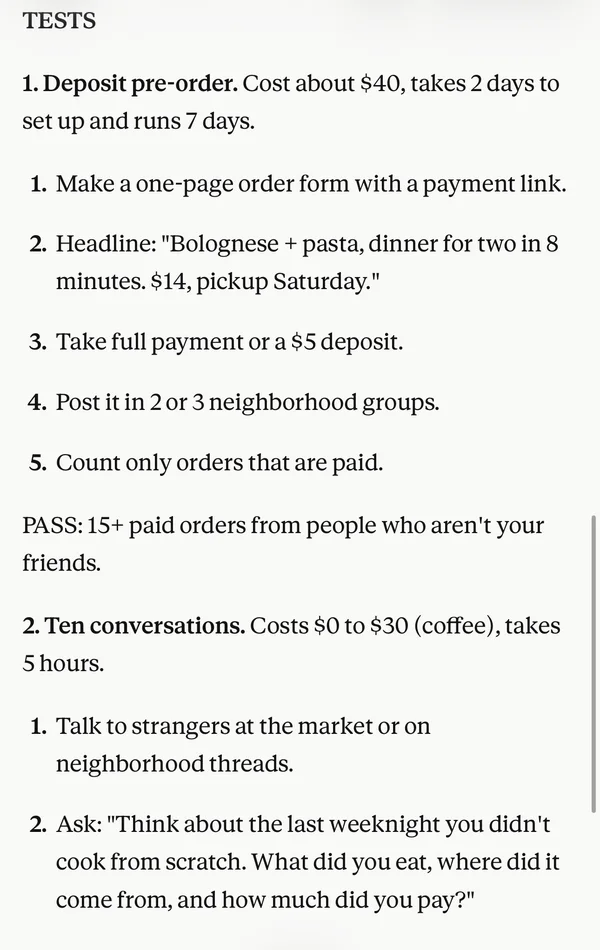
Tests with steps, cost and PASS bar
Three tests for under $200
Red flags, decision rule, what to check first
Assumptions
Local sales in Austin, TX (market stall plus neighborhood pickup), US sources, $14 per two-serving kit, and “busy weeknight households” as the customer.
Signals: where to look
1 · Buying-phrase searchesMain search engine and map app, plus autocomplete for “frozen pasta sauce near me”, “fresh pasta Austin”, “meal kit pickup Austin”
2 · Recent paid reviewsMap listings and local delivery apps for pasta shops, meal-prep services and market vendors
3 · Competitor busy-nessYour market's vendor list, nearby markets, local pasta and meal-prep shops
4 · Recommendation asksNeighborhood groups, local classifieds, parent groups
5 · Problem threadsLocal city forums, busy-parent forums
6 · Prices holdingthe same competitors, checked over time (the full table also gives what to count and the PASS bar for each signal)
Test 1 of 3 — deposit pre-order
Cost about $40, takes 2 days to set up and runs 7 days. Make a one-page order form with a payment link. Headline: “Bolognese + pasta, dinner for two in 8 minutes. $14, pickup Saturday.” Take full payment or a $5 deposit. Post it in 2 or 3 neighborhood groups. Count only orders that are paid. PASS: 15+ paid orders from people who aren't your friends.
Test 2 of 3 — ten conversations
Costs $0 to $30 (coffee), takes 5 hours. Talk to strangers at the market or on neighborhood threads. Ask: “Think about the last weeknight you didn't cook from scratch. What did you eat, where did it come from, and how much did you pay?” Follow up with: “How often does that happen in a month?” Write down the dollar amounts.
Red flags
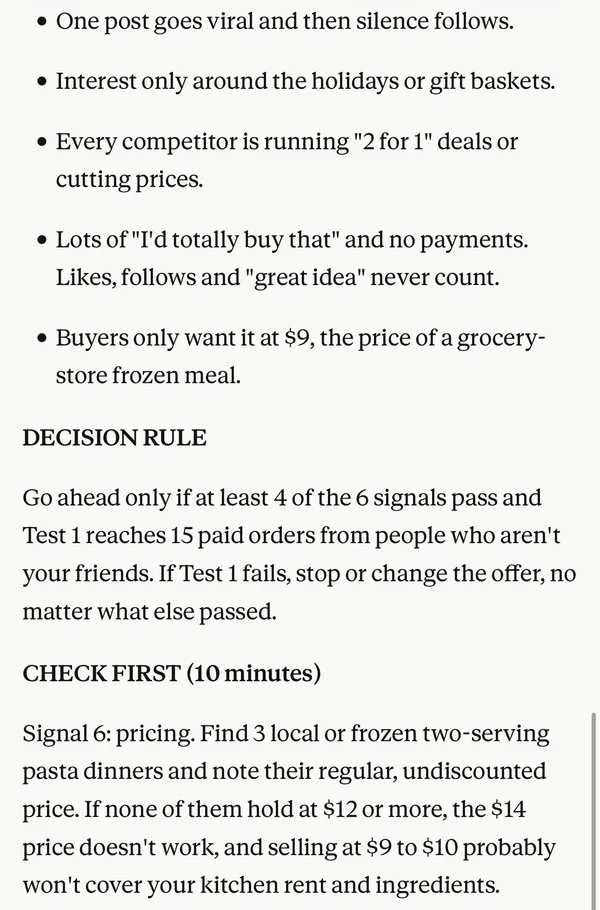
One post goes viral and then silence follows · interest only around the holidays or gift baskets · every competitor is running “2 for 1” deals or cutting prices · lots of “I'd totally buy that” and no payments; likes, follows and “great idea” never count · buyers only want it at $9, the price of a grocery-store frozen meal.
DECISION RULE — Go ahead only if at least 4 of the 6 signals pass and Test 1 reaches 15 paid orders from people who aren't your friends. If Test 1 fails, stop or change the offer, no matter what else passed.
Check first (10 minutes)
Signal 6: pricing. Find 3 local or frozen two-serving pasta dinners and note their regular, undiscounted price. If none of them hold at $12 or more, the $14 price doesn't work, and selling at $9 to $10 probably won't cover your kitchen rent and ingredients.

The prompt is not allowed to invent statistics, so instead of “the market is growing 12%” you get places to look, a bar that counts as a pass, and a rule you set before you look.

Screenshot of the tests: a deposit pre-order with the headline Bolognese + pasta, dinner for two in 8 minutes, $14, pickup Saturday; PASS: 15+ paid orders
Test 1 of 3, from the screen: a $5-deposit page with the headline it wrote, and the PASS bar.

P13 · Cost & Price Math · run in the free Claude app on a phone, 28 October 2026

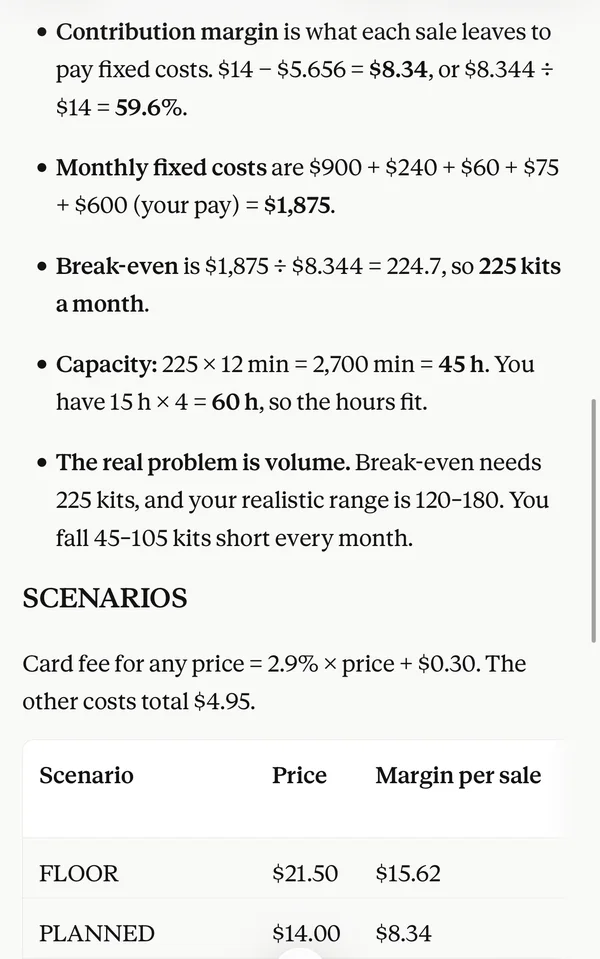
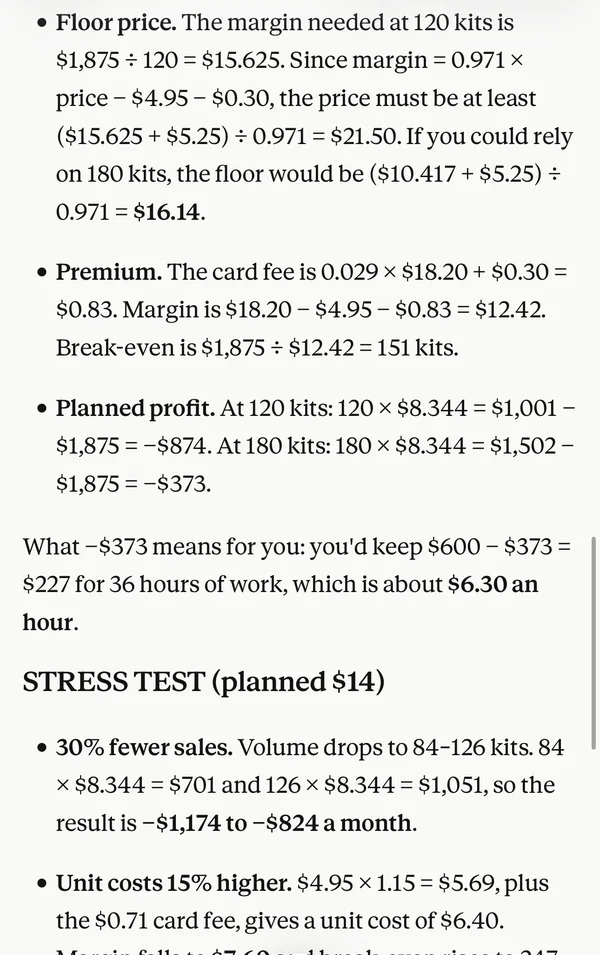
At $14 it says no: 150 kits a month leaves you minus $373, about $6.30 an hour. Then it names the price that works.

  • Full unit cost line by line, $5.66 a kit, with the missing lines flagged instead of guessed
  • Margin $8.34, break-even 225 kits a month, against your own guess of 120 to 180
  • Three scenarios: floor $21.50, planned $14, premium $18.20
  • A stress test, and the one number it trusts least: your sales guess
Read the full answer, and all 6 screens
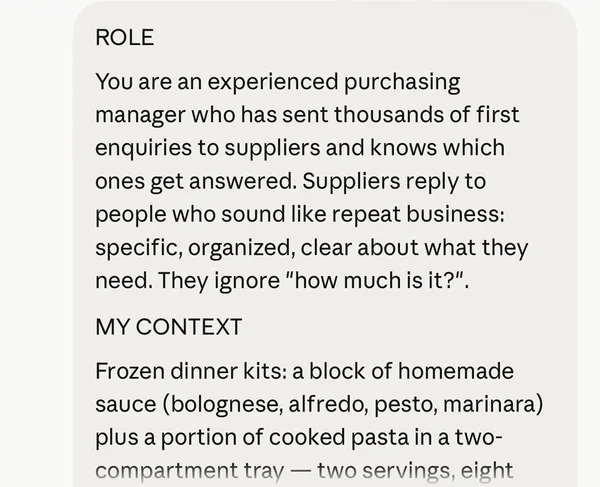
The prompt pasted into the Claude app
The prompt, pasted as is
Assumptions
Assumptions, stated first
Full unit cost table, total $5.66
Full unit cost, line by line
Margin, fixed costs, break-even, capacity
Margin, break-even, capacity
Scenarios and the stress test
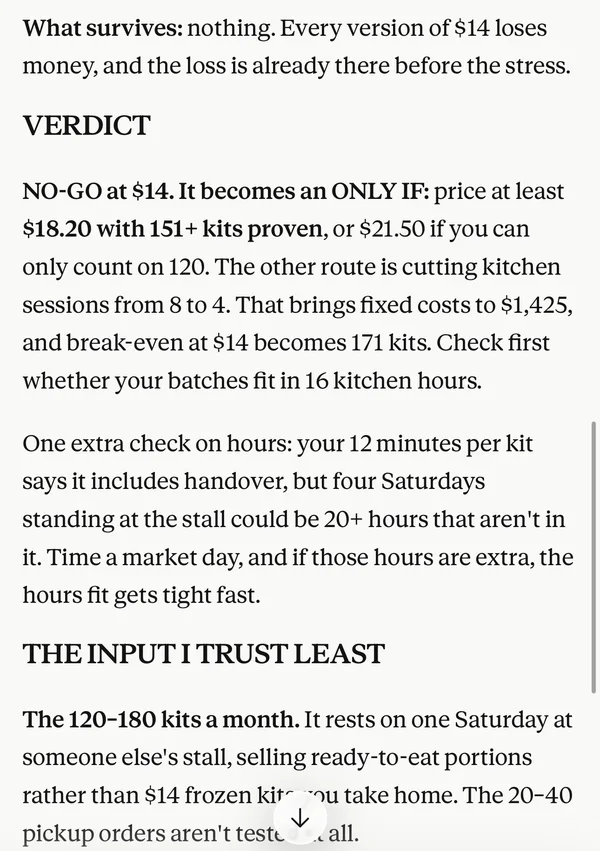
The verdict and the input it trusts least
The verdict
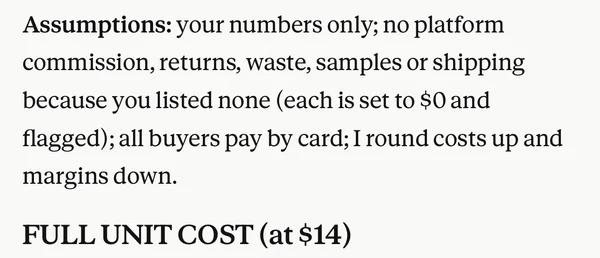
Assumptions
Your numbers only; no platform commission, returns, waste, samples or shipping because you listed none (each is set to $0 and flagged); all buyers pay by card; I round costs up and margins down.
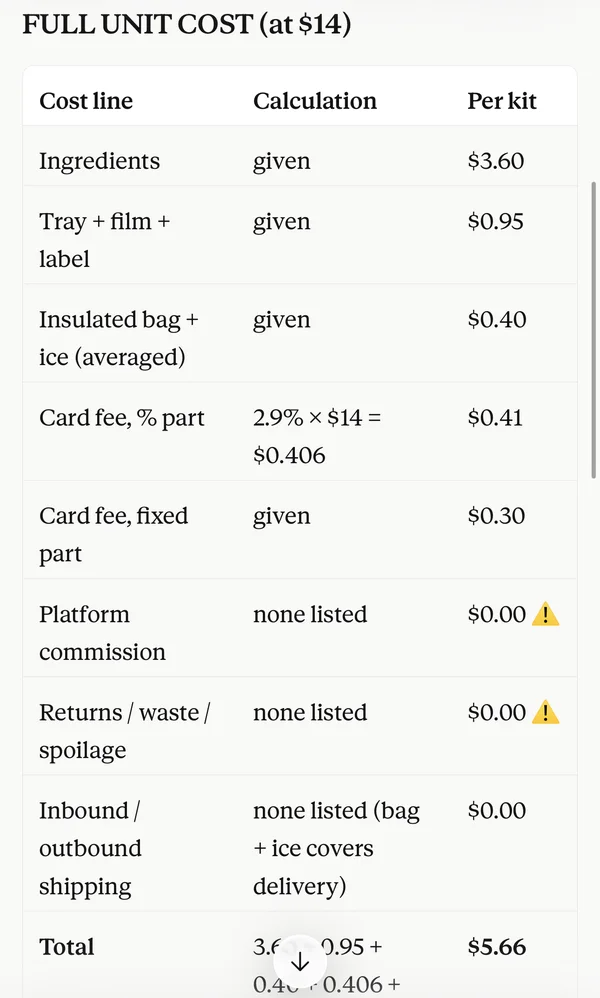
Full unit cost, at $14
Ingredientsgiven · $3.60
Tray + film + labelgiven · $0.95
Insulated bag + ice (averaged)given · $0.40
Card fee, % part2.9% × $14 = $0.406 · $0.41
Card fee, fixed partgiven · $0.30
Platform commissionnone listed · $0.00, flagged
Returns / waste / spoilagenone listed · $0.00, flagged
Inbound / outbound shippingnone listed (bag + ice covers delivery) · $0.00
Total$5.66
The core math
Contribution margin is what each sale leaves to pay fixed costs. $14 − $5.656 = $8.34, or $8.344 ÷ $14 = 59.6%. Monthly fixed costs are $900 + $240 + $60 + $75 + $600 (your pay) = $1,875. Break-even is $1,875 ÷ $8.344 = 224.7, so 225 kits a month. Capacity: 225 × 12 min = 2,700 min = 45 h. You have 15 h × 4 = 60 h, so the hours fit. The real problem is volume. Break-even needs 225 kits, and your realistic range is 120–180. You fall 45–105 kits short every month.
Scenarios · card fee for any price = 2.9% × price + $0.30; the other costs total $4.95
FLOOR $21.50margin $15.62 · the margin needed at 120 kits is $1,875 ÷ 120 = $15.625, so the price must be at least ($15.625 + $5.25) ÷ 0.971 = $21.50; if you could rely on 180 kits, the floor would be $16.14
PLANNED $14.00margin $8.34 · at 120 kits: 120 × $8.344 = $1,001 − $1,875 = −$874; at 180 kits: $1,502 − $1,875 = −$373
PREMIUM (+30%) $18.20margin $12.42 · card fee 0.029 × $18.20 + $0.30 = $0.83; break-even $1,875 ÷ $12.42 = 151 kits
What −$373 means for you: you'd keep $600 − $373 = $227 for 36 hours of work, which is about $6.30 an hour.
Stress test, planned $14
30% fewer sales: volume drops to 84–126 kits, 84 × $8.344 = $701 and 126 × $8.344 = $1,051, so the result is −$1,174 to −$824 a month. Unit costs 15% higher: $4.95 × 1.15 = $5.69, plus the $0.71 card fee, gives a unit cost of $6.40; margin falls to $7.60 and break-even rises to 247 kits (49.4 h); at 120–180 kits the result is −$963 to −$507. What survives: nothing. Every version of $14 loses money, and the loss is already there before the stress.
VERDICT — NO-GO at $14. It becomes an ONLY IF: price at least $18.20 with 151+ kits proven, or $21.50 if you can only count on 120. The other route is cutting kitchen sessions from 8 to 4. That brings fixed costs to $1,425, and break-even at $14 becomes 171 kits. Check first whether your batches fit in 16 kitchen hours.
One extra check on hours: your 12 minutes per kit says it includes handover, but four Saturdays standing at the stall could be 20+ hours that aren't in it. Time a market day, and if those hours are extra, the hours fit gets tight fast.
The input I trust least
The 120–180 kits a month. It rests on one Saturday at someone else's stall, selling ready-to-eat portions rather than $14 frozen kits you take home. The 20–40 pickup orders aren't tested at all.

Every line is a written calculation with your numbers, and the prompt is not allowed to round in your favour. At these numbers it says no, and shows exactly why.

Screenshot of the verdict: NO-GO at $14, ONLY IF price at least $18.20 with 151+ kits proven, or cut kitchen sessions from 8 to 4
The verdict, from the screen: NO-GO at $14, ONLY IF $18.20 with 151+ kits proven, or half the kitchen hours.
P15 · Supplier OutreachA 145-word quote request that sounds like repeat business, a day-5 follow-up, and the three things suppliers hide from beginners.
  • The email, with the specifics a supplier prices on and a request for an itemized quote
  • A three-line follow-up for day five
  • “Get in writing”: MOQ, lead time, sample terms, price breaks, payment terms, defects
  • What was still too vague to price: snap lids or lidding film are two different products
The prompt pasted into the Claude app
The prompt, pasted as is
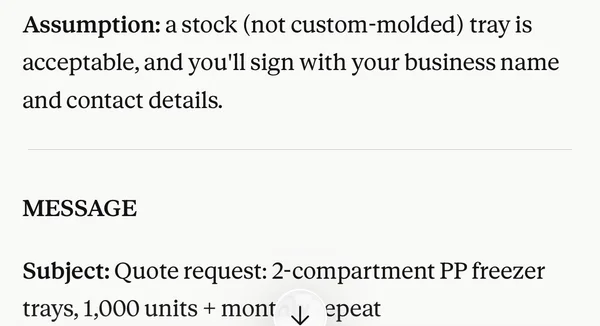
Assumption and the subject line
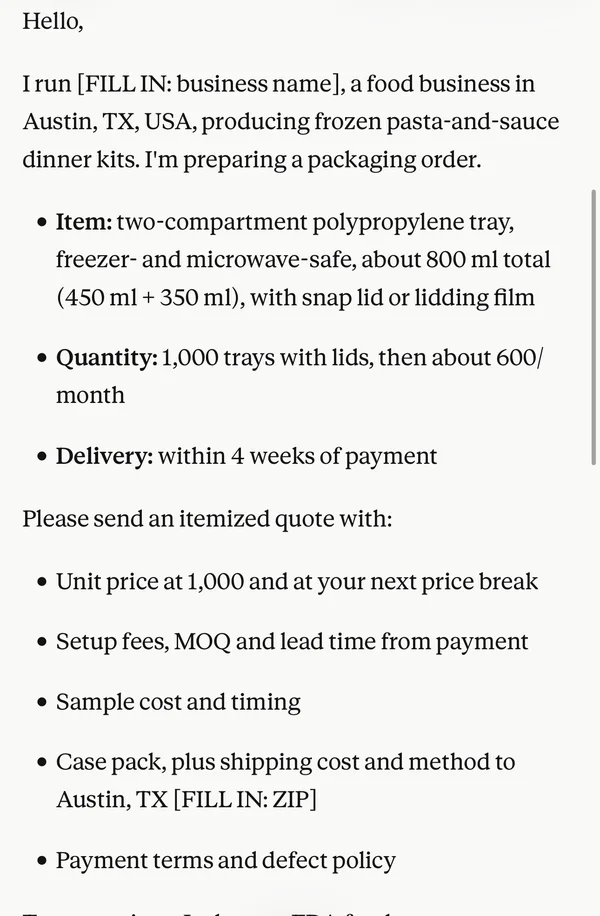
The message, ready to send
Follow-up and the checklist
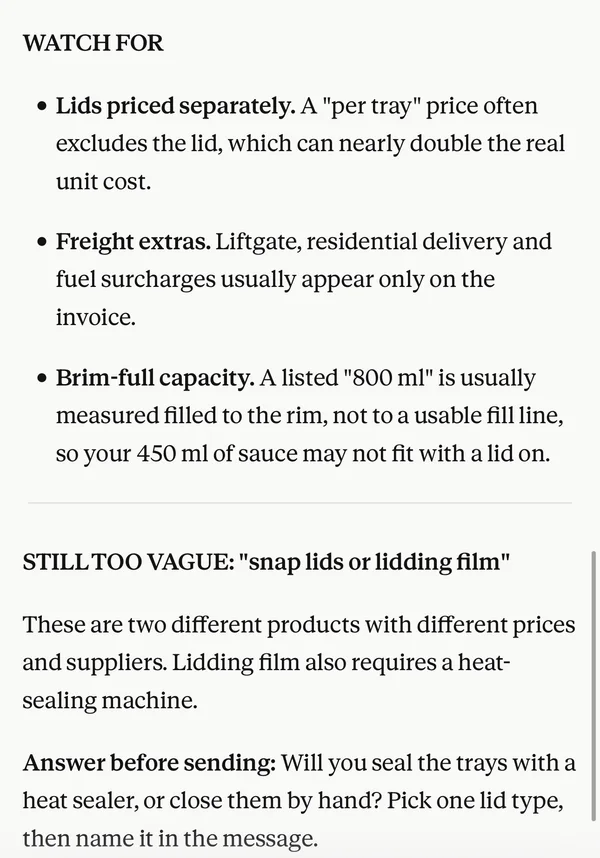
What suppliers hide, and what is still too vague
What suppliers hide
Assumption
A stock (not custom-molded) tray is acceptable, and you'll sign with your business name and contact details.
Message · about 145 words
Subject: Quote request: 2-compartment PP freezer trays, 1,000 units + monthly repeat

Hello, I run [FILL IN: business name], a food business in Austin, TX, USA, producing frozen pasta-and-sauce dinner kits. I'm preparing a packaging order. Item: two-compartment polypropylene tray, freezer- and microwave-safe, about 800 ml total (450 ml + 350 ml), with snap lid or lidding film. Quantity: 1,000 trays with lids, then about 600/month. Delivery: within 4 weeks of payment.

Please send an itemized quote with: unit price at 1,000 and at your next price break; setup fees, MOQ and lead time from payment; sample cost and timing; case pack, plus shipping cost and method to Austin, TX [FILL IN: ZIP]; payment terms and defect policy. Two questions. Is the tray FDA food-contact compliant, and what temperature range is it rated for? Does the lid seal hold at 0°F? Thank you, [FILL IN: name, phone]
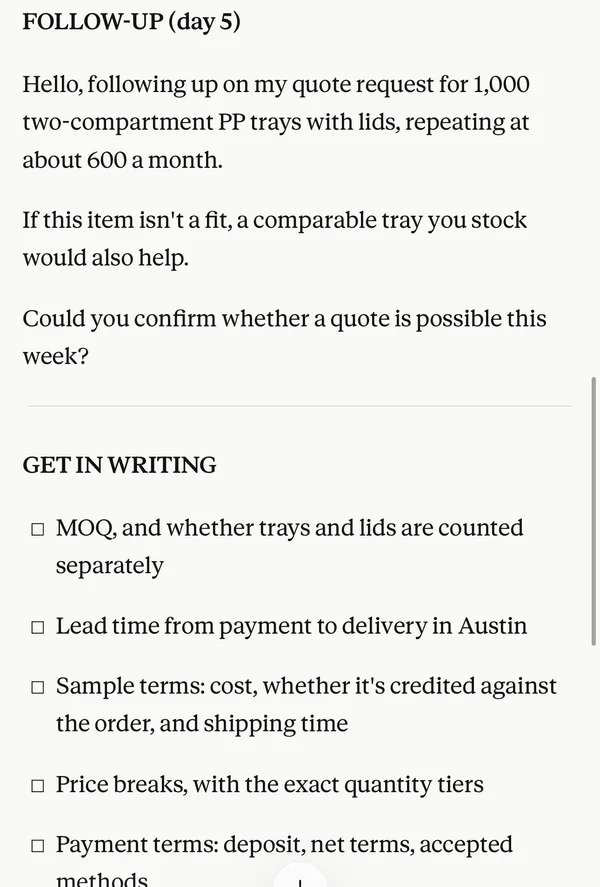
Follow-up, day 5
Hello, following up on my quote request for 1,000 two-compartment PP trays with lids, repeating at about 600 a month. If this item isn't a fit, a comparable tray you stock would also help. Could you confirm whether a quote is possible this week?
Get in writing
MOQ, and whether trays and lids are counted separately · lead time from payment to delivery in Austin · sample terms: cost, whether it's credited against the order, and shipping time · price breaks, with the exact quantity tiers · payment terms: deposit, net terms, accepted methods · defect and return policy: what counts as a defect, the claim window, credit or replacement · quote validity, in days.
Watch for
Lids priced separatelyA “per tray” price often excludes the lid, which can nearly double the real unit cost.
Freight extrasLiftgate, residential delivery and fuel surcharges usually appear only on the invoice.
Brim-full capacityA listed “800 ml” is usually measured filled to the rim, not to a usable fill line, so your 450 ml of sauce may not fit with a lid on.
Still too vague: “snap lids or lidding film”
These are two different products with different prices and suppliers. Lidding film also requires a heat-sealing machine. Answer before sending: will you seal the trays with a heat sealer, or close them by hand? Pick one lid type, then name it in the message.

No budget, no deadline pressure, no “this is my first order”. The prompt's rules keep you sounding like repeat business, which is who suppliers answer.

Buy the pack, $9 All fifty, PDF and plain text, by email right after checkout.

It's the prompt, not the AI.

Type one line and you get tips. Give the AI a role, your context, a method, an exact output and a few hard rules, and you get work. Toggle between the two.

The difference is not the AI, it is what you hand it. The second version gives it a real job title instead of “business expert”, your own context instead of nothing, a rule to ask before it guesses, a method, an exact output format and a few hard rules such as “no invented facts”. That is all a prompt from the pack is. It looks long because it is doing the thinking for you.

Typical request tips you could google
act as a business expert and help me write a description for my product
Here are some tips for writing a great product description: 1. Know your audience. 2. Highlight the benefits. 3. Use clear, simple language. 4. Add a call to action…
No role, nothing about your product, no rules, no format. The AI has no choice but to answer with generic advice.

Idea to first customer, in order.

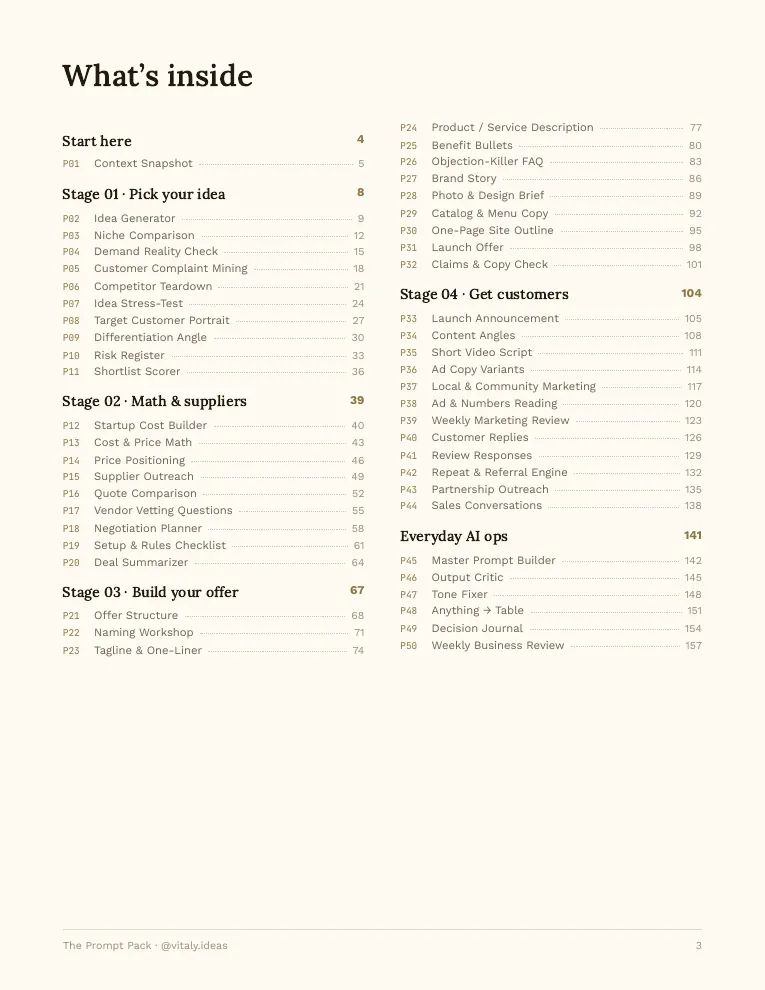
Fifty prompts in four stages. You start at stage 01 with nothing but an idea and finish at stage 04 with your first customers. Works for a coffee stand, a clothing brand, an online store or a service business.

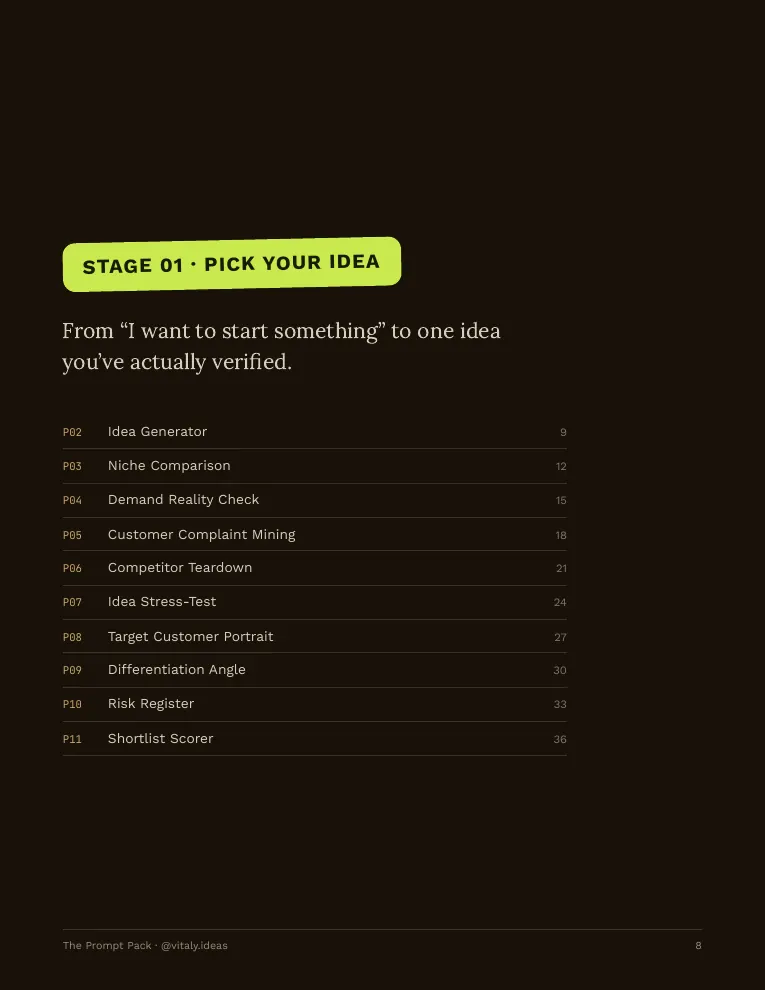
Stage 0110 prompts, P02–P11

Pick your idea

Compare niches, stress-test the idea, and find out what customers of similar businesses actually complain about, before you commit to anything.

All 10 prompts in this stage
  1. P02Idea Generator
  2. P03Niche Comparison
  3. P04Demand Reality Check
  4. P05Customer Complaint Mining
  5. P06Competitor Teardown
  6. P07Idea Stress-Test
  7. P08Target Customer Portrait
  8. P09Differentiation Angle
  9. P10Risk Register
  10. P11Shortlist Scorer
Stage 029 prompts, P12–P20

Do the math & find suppliers

Figure out costs, pricing and break-even in plain numbers, then message suppliers and contractors like someone who has done this before.

All 9 prompts in this stage
  1. P12Startup Cost Builder
  2. P13Cost & Price Math
  3. P14Price Positioning
  4. P15Supplier Outreach
  5. P16Quote Comparison
  6. P17Vendor Vetting Questions
  7. P18Negotiation Planner
  8. P19Setup & Rules Checklist
  9. P20Deal Summarizer
Stage 0312 prompts, P21–P32

Build your offer

Name it, describe it, price it, brief the visuals. Copy that sounds like you and sells the thing, not "premium quality solutions".

All 12 prompts in this stage
  1. P21Offer Structure
  2. P22Naming Workshop
  3. P23Tagline & One-Liner
  4. P24Product / Service Description
  5. P25Benefit Bullets
  6. P26Objection-Killer FAQ
  7. P27Brand Story
  8. P28Photo & Design Brief
  9. P29Catalog & Menu Copy
  10. P30One-Page Site Outline
  11. P31Launch Offer
  12. P32Claims & Copy Check
Stage 0412 prompts, P33–P44

Get customers

Content angles, ad copy, and a weekly 30-minute review that tells you where the money's leaking and what's worth scaling.

All 12 prompts in this stage
  1. P33Launch Announcement
  2. P34Content Angles
  3. P35Short Video Script
  4. P36Ad Copy Variants
  5. P37Local & Community Marketing
  6. P38Ad & Numbers Reading
  7. P39Weekly Marketing Review
  8. P40Customer Replies
  9. P41Review Responses
  10. P42Repeat & Referral Engine
  11. P43Partnership Outreach
  12. P44Sales Conversations
Stage +7 prompts, P01–P50

Everyday AI ops

Fill in your business context once. Every other prompt reuses it, so you never start a chat from zero again.

All 7 prompts in this stage
  1. P01Context Snapshot
  2. P45Master Prompt Builder
  3. P46Output Critic
  4. P47Tone Fixer
  5. P48Anything → Table
  6. P49Decision Journal
  7. P50Weekly Business Review

Read two before you pay.

The exact texts from the pack, not samples. The other 48 are built the same way, each with its own guide page.

P01

Context Snapshot

The one you run first: ten minutes of questions, and every other prompt knows your business.
Read it

Ten minutes of questions now make every other prompt in this pack sound like it already knows your business.

Full prompt, 344 words, exactly as in the pack
ROLE
You are my launch assistant: a patient, practical interviewer who has helped hundreds of first-time founders describe their business clearly. Your only job today is to understand my situation and write it down. No advice yet.

BEFORE YOU START
Ask me one question at a time and wait for my answer. Never skip ahead, never assume. If an answer is vague ("some money", "when I can"), ask once for a number or a range. Keep the whole interview to 9 questions maximum.

METHOD - ask, in this order
1. What I'm launching, or the 2-3 ideas I'm choosing between.
2. My customer in one sentence: who they are, where they are, what they are trying to get done.
3. Where I'll sell: online, local, both - and the specific channels I already have or can reach.
4. The country and city I operate in, and the currency I think in.
5. My total budget ceiling for the launch, as a number.
6. Hours per week I can really give this, as a number.
7. Skills, tools, contacts and assets I already have (be concrete: "I can edit video", "I know a printer").
8. My pricing thoughts so far, if any.
9. My deadline or target launch date, and the reason behind it.

OUTPUT
After the last answer, produce exactly two things:
- A block titled BUSINESS CONTEXT SNAPSHOT, under 150 words, in the first person, using my numbers and my words, so I can paste it into other prompts. Order: Business / Customer / Channels / Location & currency / Budget / Time / Assets / Pricing thoughts / Deadline.
- One line titled STILL UNKNOWN listing anything I couldn't answer.

RULES
- No commentary, no encouragement, no advice - the snapshot only.
- Use my exact figures; never round a budget up or invent a detail I didn't give you.
- If I said "I don't know", write "unknown", not a guess.

FINISH WITH
The sentence: "Save this snapshot - paste it at the top of every prompt that asks for it."
P33

Launch Announcement

From stage 04: your launch as a three-message sequence, per channel, with the version friends can forward.
Read it

A three-message launch sequence per channel — tease, doors open, last call — so your launch is a week of attention, not one post that disappears in an hour.

Full prompt, 484 words, exactly as in the pack
ROLE
You are a launch copywriter who has opened dozens of small businesses to tiny audiences. You know a launch is a sequence, not a post: a tease that earns attention, an open that gives one clear action, and a last call that gives the undecided a reason to act now. You write like a person, not a brand.

MY CONTEXT
[PASTE BUSINESS CONTEXT SNAPSHOT] My one-liner: [from P23] Launch offer, with its real end date or limit: [from P31] Where to buy or visit: [link / address / "message me"] Channels I will announce on: [personal chats / one local group / social platforms / email list] Why I started, in one true sentence: [optional]

BEFORE YOU START
If the launch offer has no end date or limit, or I named no channel, ask for that first, one question at a time, three questions maximum. Otherwise state your assumptions in one line and begin.

METHOD
1. Build the sequence. TEASE, 3-5 days before opening: what is coming, for whom, one concrete detail that proves it is real, and a question or a "want to know first?" so replies show me who is warm. OPEN, launch day: what it is, who it is for, the offer, how to buy, one action. LAST CALL, 24-48 hours before the offer ends: what people said so far (only if true), what ends, the same action. Three messages, no more.
2. Adapt each message to each channel: chats and stories get 2 lines; group posts stay under 80 words, story first and offer last; feed posts under 150 words; email under 200 words with a subject line.
3. End every message with exactly one action, and keep the same action across the sequence so people learn it.
4. Write the "send to friends" version: a message they can forward in one tap, plus the exact sentence I use to ask them to forward it. Word of mouth is my first channel, and unasked shares do not happen.
5. Check every line against my material: no claim, price or deadline that I did not give you.

OUTPUT
LAUNCH CALENDAR: a table with columns Day / Channel / Message (tease, open, last call) / Action it asks for. Then each message in full under a heading CHANNEL - MESSAGE, with its word count. Then FRIENDS VERSION with the forwarding ask. Then one line titled WHAT TO PREPARE: link, photo, reply time, so nothing breaks on the day.

RULES
- Use only my offer, dates, prices and details; mark anything missing as FIND OUT rather than inventing it.
- Plain language, contractions, no corporate speak, no exclamation marks.
- No fake scarcity: a limit or deadline appears only if I gave you one.
- Voice: a person opening something they are proud of, warm and direct.

FINISH WITH
The one thing I should prepare before the tease goes out, and why.

Nine dollars, one time.

It runs on the free ChatGPT or Claude. Each prompt asks up to three questions and then delivers, so you are not burning a paid limit on back-and-forth.

$9 $17

Launch price for the first 100 buyers, then $17.

All 50 prompts, 400–550 words each, sequenced from idea to first customers
A guide page for every prompt: when to run it, what to have ready, what to ask next
Context Snapshot starter: fill it once, every prompt knows your business
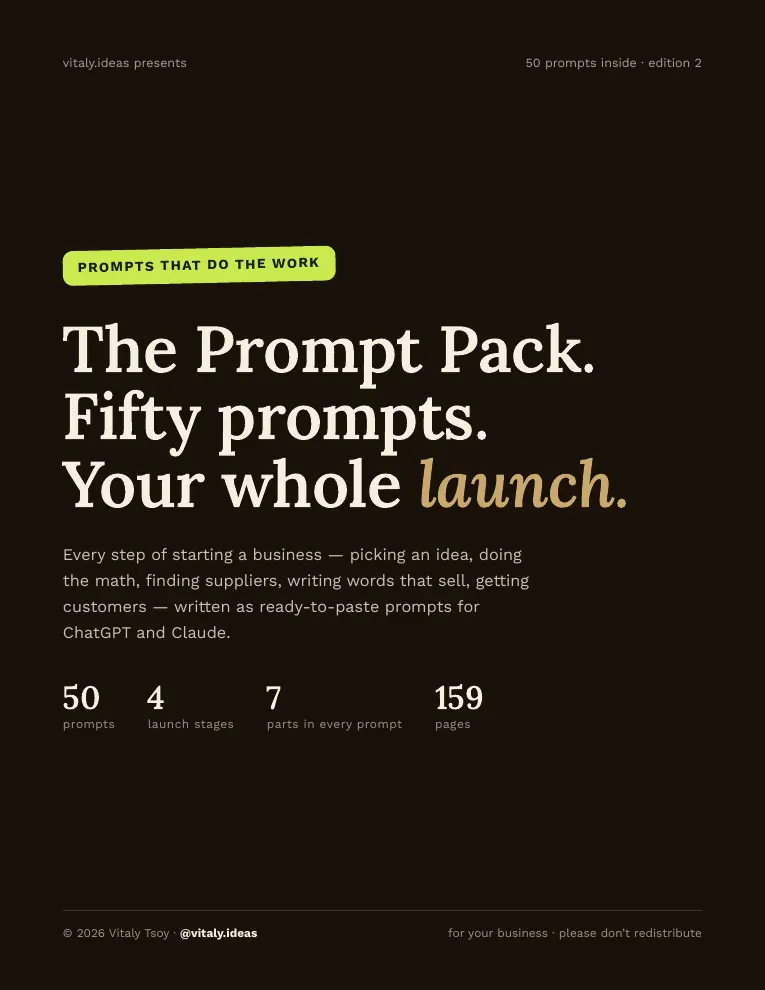
Two files by email: the 159-page PDF and a plain-text file to copy from in one selection
Buy the pack, $9

One-time payment. Instant access. Free ChatGPT or Claude is enough.

It's a digital product: once the files are downloaded there's no refund, so read the two full prompts above first. If a file won't open, reply to your order email and it gets sorted.

Questions I get.

Will these work for my kind of business?

They are written for launching a product or a service in any category: a food stand, a clothing brand, an online store, a local service. The steps are the same for all of them. Where a step does not apply to you, skip it.

Which AI do I need?

ChatGPT or Claude, the free versions are enough. I tested every prompt on both. A paid plan only makes it faster.

How detailed are the prompts?

Each one is 400 to 550 words and has seven parts: a real role, your context, a rule that the AI asks up to three questions before guessing, a step-by-step method, an exact output format, hard rules against invented facts, and a defined ending. You can read two of them in full above.

How do I get it?

Right after checkout you get an email with two files: the 159-page PDF with every prompt and its guide page, and a plain-text file with all 50 prompts, so you can copy any of them in one selection. They open on any device.

Why not just use free prompt lists?

You have probably tried them. That is how you got the "here are some tips" answer. Free lists have no role, no place for your context, no method, no rules and no output format. These have all of that, and they come in the order a real launch needs them.

Will the prompts get outdated when AI models change?

What makes them work is the structure: role, context, method, rules, format. That carries across model versions. If I build expanded editions later, those will be separate releases.

Who is this NOT for?

If you already run a business with a team and a marketing budget, you will find these too basic. They are written for a first launch with little money and a few hours a week. And if you want the AI to decide for you, it will not: every prompt makes you supply the facts and sets a pass bar you have to meet.
Can I get a refund?

It is a digital product delivered by email, so once the files are downloaded a refund is not possible. That is the platform's rule for digital goods, and it is why everything inside is laid out on this page before you buy: the four stages, what each covers, three runs, two prompts in full. If a file will not open or the email never arrived, reply to the order email and it gets sorted out.

Not ready? Take prompt one, free.

Context Snapshot: ten questions, and one paste-anywhere summary of your business comes back. Run it tonight and keep the result. If you come back for the pack, every other prompt will already know your business.

Something went wrong, please try again.
The prompt opens on the next page; copy it and bookmark it. I write to the list occasionally, when a new pack or a new idea breakdown is out, and you can unsubscribe with one reply. Your email is never shared.

That's the whole pack.

You have seen two prompts in full and three of them running. The other 45 are in your inbox a minute after checkout. Fifty prompts, nine dollars.

One-time payment. Instant access. Two files by email.